Trending...
- California: Governor Newsom launches first new conservancy in 15 years to accelerate progress at the Salton Sea - 154
- Art In Stone, a 40-Year Bay Area Monument Leader, Launches Newly Renovated Website - 119
- InterMountain Management Announces the Re-opening of Holiday Inn Express & Suites Alexandria
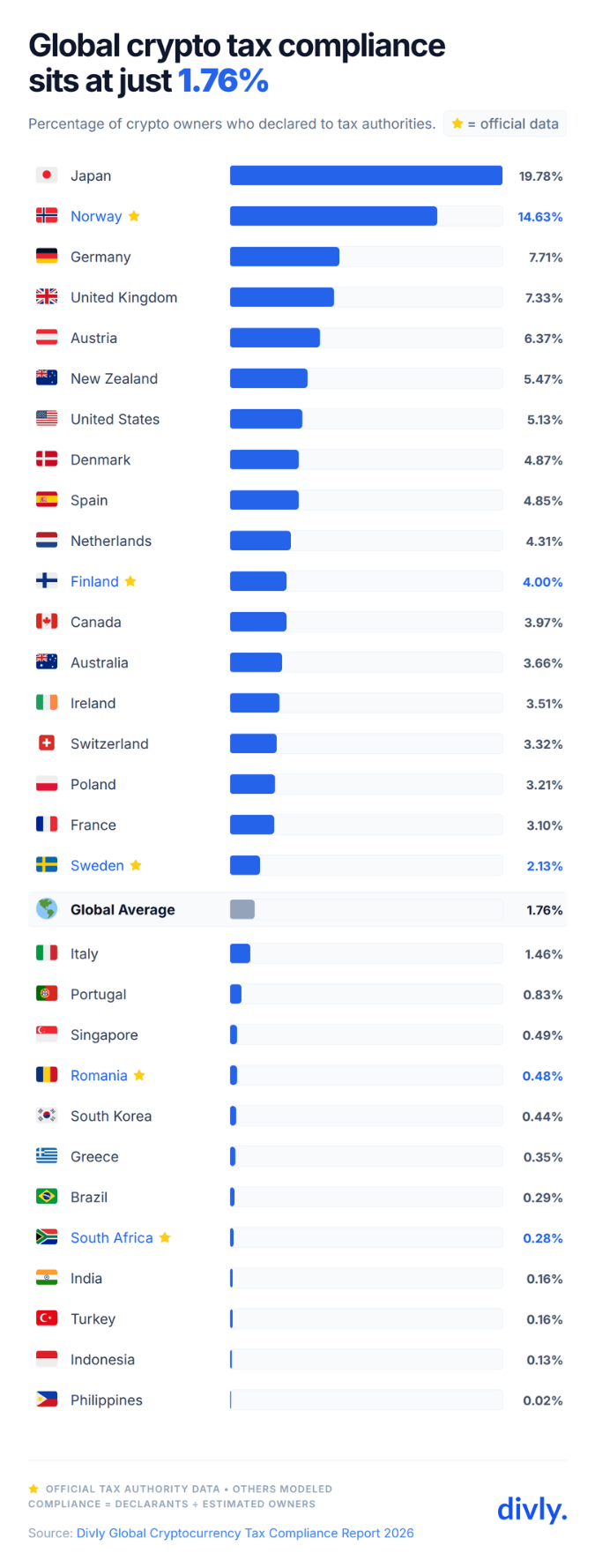
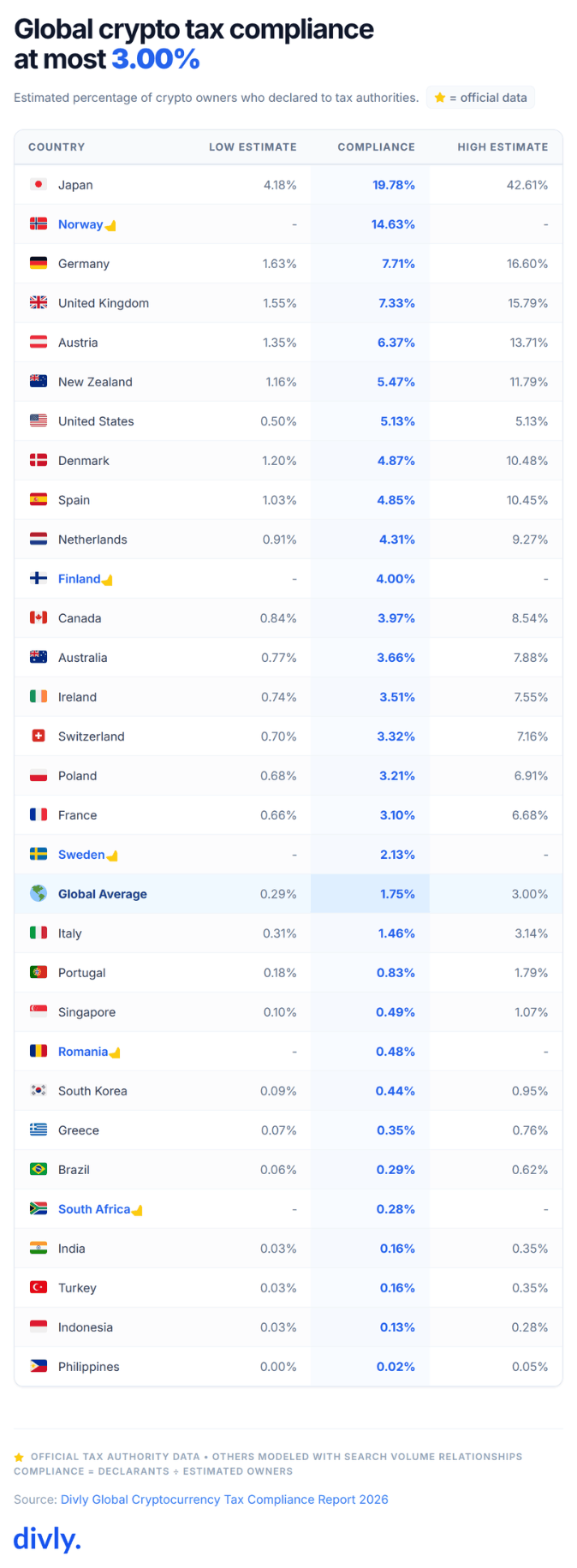

Divly's Global Cryptocurrency Taxation Report 2026 estimates that only 1.76% of crypto owners declare for tax purposes, based on official country data and modeled global estimates ahead of a major new reporting era.
STOCKHOLM - Californer -- Divly, a crypto tax calculator, has published its Global Cryptocurrency Taxation Report 2026, finding that crypto tax compliance appears to remain very low across much of the market.
The report estimates that just 1.76% of crypto owners declare their crypto for tax purposes. Even in Divly's high scenario, the figure rises only to 3.00%, implying that over 97% of crypto owners still appear not to declare.
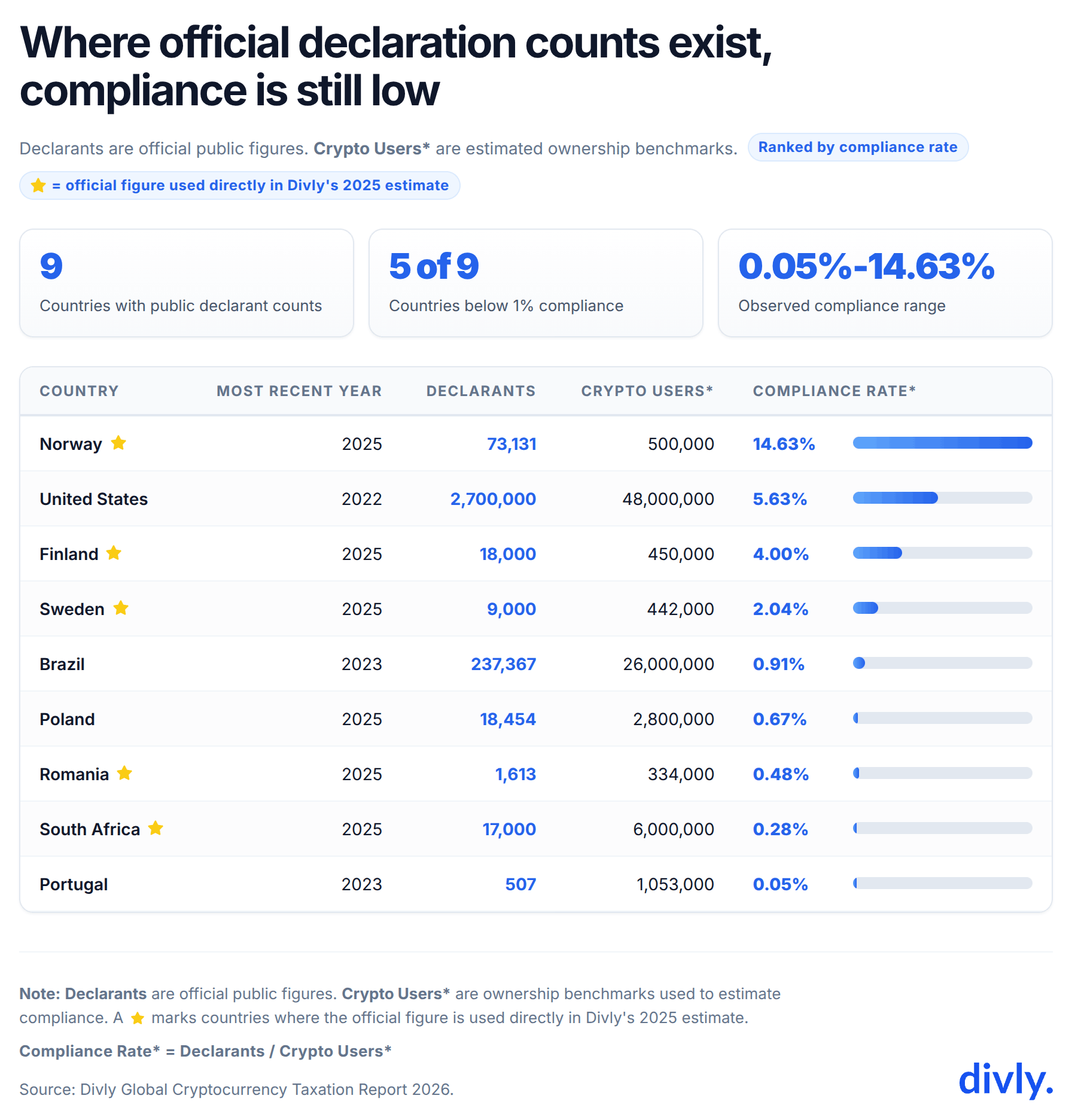
To reach that estimate, Divly combined official declaration figures, public reporting, and crypto ownership benchmarks. The report found usable official declaration data from nine countries, five of them from the last year. To extend the analysis across the wider market, Divly then analyzed more than 12 million crypto-tax-related searches and used the relationship between tax-search demand and official declaration counts to model low, medium, and high compliance scenarios.
More on The Californer
The official data points in the same direction across countries: where declaration figures exist, compliance is often low and in some markets extremely low. At the same time, the report identifies wide differences between countries, with some jurisdictions showing much stronger reporting than others.
The report also lands at a significant moment for the crypto tax landscape. In the United States, Form 1099-DA has begun bringing 2025 digital asset sales into the 2026 filing season. In the EU and other jurisdictions implementing the OECD's Crypto-Asset Reporting Framework, 2026 transactions are already entering reporting pipelines that will begin reaching tax authorities in 2027.
That makes the report a snapshot of crypto tax compliance just before tax visibility increases materially. If reporting still appears this low as those systems begin to take effect, the findings suggest that the global crypto tax gap could face much greater enforcement pressure in the years ahead.
The report estimates that just 1.76% of crypto owners declare their crypto for tax purposes. Even in Divly's high scenario, the figure rises only to 3.00%, implying that over 97% of crypto owners still appear not to declare.
To reach that estimate, Divly combined official declaration figures, public reporting, and crypto ownership benchmarks. The report found usable official declaration data from nine countries, five of them from the last year. To extend the analysis across the wider market, Divly then analyzed more than 12 million crypto-tax-related searches and used the relationship between tax-search demand and official declaration counts to model low, medium, and high compliance scenarios.
More on The Californer
- City of Long Beach Invites Youth Ages 13 to 26 to Attend Three-Day Empowerment Event
- Keenethics enters the ChatGPT Apps ecosystem as a new growth opportunity for businesses
- 'Into the Cole: A Tribute to Nat King Cole' Arrives at Catalina Jazz Club starring Aaron Akins
- Free Home Improvement Expo Returns to Long Beach on May 30
- Spring Into Your New Home at Heritage at South Brunswick
The official data points in the same direction across countries: where declaration figures exist, compliance is often low and in some markets extremely low. At the same time, the report identifies wide differences between countries, with some jurisdictions showing much stronger reporting than others.
The report also lands at a significant moment for the crypto tax landscape. In the United States, Form 1099-DA has begun bringing 2025 digital asset sales into the 2026 filing season. In the EU and other jurisdictions implementing the OECD's Crypto-Asset Reporting Framework, 2026 transactions are already entering reporting pipelines that will begin reaching tax authorities in 2027.
That makes the report a snapshot of crypto tax compliance just before tax visibility increases materially. If reporting still appears this low as those systems begin to take effect, the findings suggest that the global crypto tax gap could face much greater enforcement pressure in the years ahead.
Source: Divly
Filed Under: Financial, Investment
0 Comments
Latest on The Californer
- Maitrics Launches Agentic Brand Intelligence Platform for Challenger
- Anglepoint named a Customers' Choice in the 2026 Gartner Peer Insights Voice of the Customer
- Dual-Engine Growth Strategy Unleashed Targeting a $9.1B Market and the Exploding AI Biotech Revolution: KALA BIO (N A S D A Q: KALA)
- SYOKAMI Launches 15-Piece Magnetic Knife Set Featuring a Detachable Steak Block and Built-In Sharpener
- A3 Analytics Collaborates with PacBio to Reduce Downtime with AI Troubleshooting
- Plaza Mexico Celebrates 'Festival Día del Niño'
- GitKraken Desktop 12.0 Introduces Agent Mode: Gives Developers Ultimate Control & Visualization While Scaling Parallel Agent Workflows
- 5 Things to Check Before Calling for AC Repair in Philly
- Go Dental Clinic Announces Upcoming Opening of New Branch in International City, Dubai
- DJIUSA Kicks Off Big April Sale With Discounts on DJI's Gimbal Camera Lineup
- Newport Harbor Football Opens 2026 Season in Hawaii with Special Return to the Islands
- Governor Newsom delivers $520 million in utility bill relief to millions of Californians with more coming this summer
- Tax Day Reminder: California pays Trump's bills
- Hazel E Hosts Starline Tours Bus to Sonic Desert - A Launch to Coachella
- Rachel Farris, CPA Named to CPA Practice Advisor 40 Under 40 List
- Rachel Farris Named to Forbes 2026 Best-In-State CPAs List
- Promoting Health One Item at a Time
- Ali Uyanik Joins Snell & Wilmer Palo Alto Office as Counsel
- Long Beach: City Announces Second Round of Backyard Builders Loan Program to Help Lower-Income Homeowners Build ADUs
- National Award: Workforce Development Board Ventura County Honored with 2026 WIOA Trailblazer Award