Trending...
- Dynamic Dachshund Dog Goes Global: Remember Point Launches a New Bilingual Children's Book - 222
- Salestrics' $1.5 Million SAFE Financing Round Remains Open Following $148,500 Pre-Seed Investment - 109
- Salestrics Releases Version 2.0 to Unify CRM, Business Email, and Operations on a Single Customer Graph
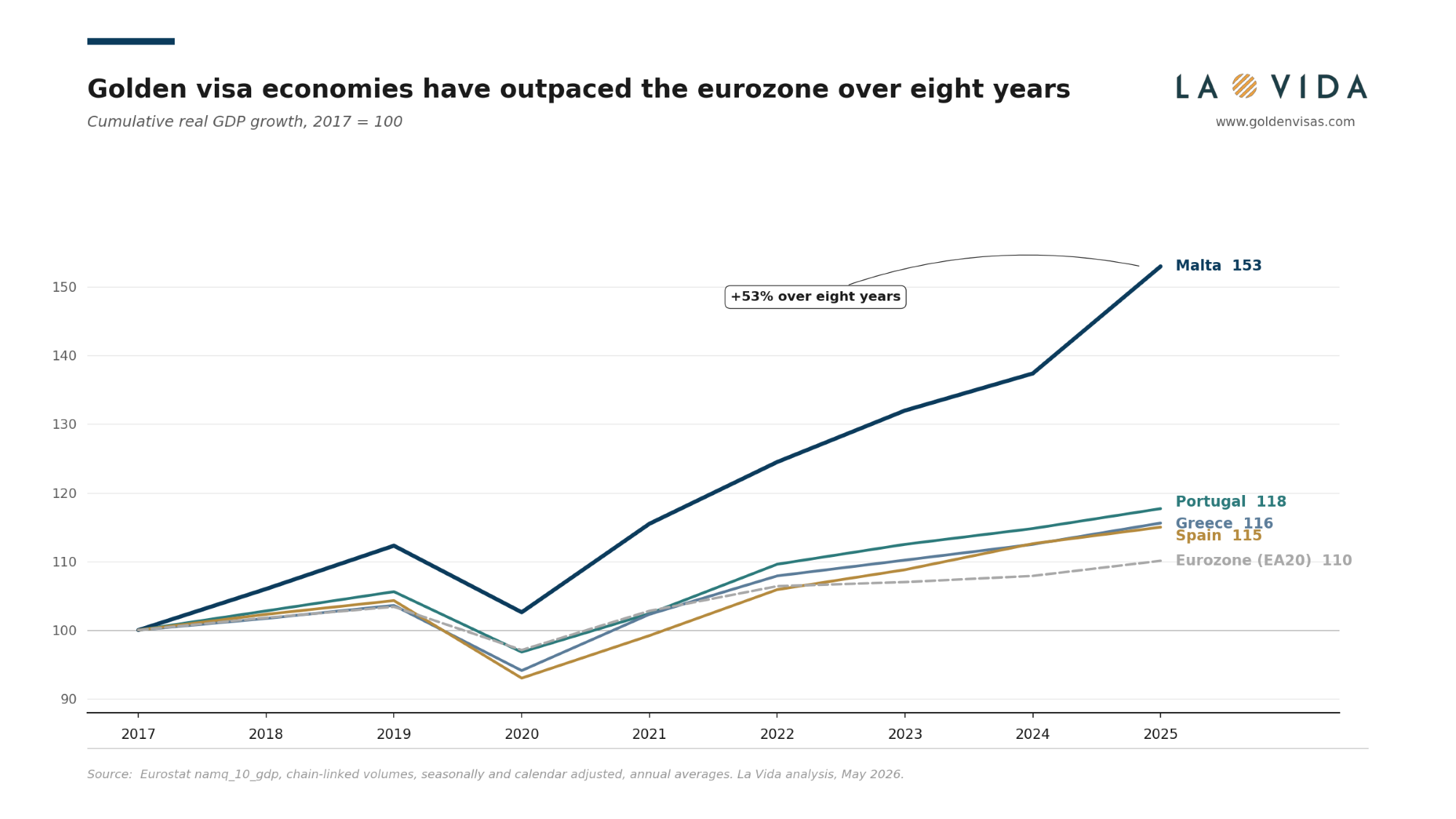

Real GDP in Malta, Portugal, Greece and Spain grew faster than the eurozone average from 2017 to 2025, according to research published today by investment migration firm La Vida. The four economies — all of which operated investment migration programmes throughout the period — outperformed the bloc on both aggregate and per-capita measures.
UXBRIDGE, U.K. - Californer -- LONDON — The four European countries that ran continuous investment migration programmes from 2017 to 2025 each grew faster in real GDP terms than the eurozone average, new analysis from UK-based investment migration advisory firm La Vida has found.
Drawing on official Eurostat national accounts data, the research shows Malta's economy grew 53% in real terms over the eight years, Portugal by 17.7%, Greece by 15.6% and Spain by 15.0%. The eurozone aggregate over the same period grew 10.1%.
The pattern holds when adjusted for population. On a real GDP-per-capita basis, Malta grew by 22.4%, Greece by 19.3%, Portugal by 12.9% and Spain by 8.8%, against a eurozone figure of 7.7%.
More on The Californer
Direct investment associated with the programmes themselves is too small to account for the difference. La Vida estimates the qualifying investment generated by the four programmes sits in the range of 0.025% to 0.25% of national GDP per year — an order of magnitude or more below the size of the growth gaps observed.
Paul Williams, CEO and Founder of La Vida, said:
"European economies are struggling for growth while government debt continues to climb. Governments and the EU need to take a closer look at the role residency and citizenship by investment can play in attracting productive wealth into their economies. Our analysis doesn't prove the programmes drove the growth gap. But the direction of the data is hard to ignore, and the contribution of wealthy migrants extends well beyond their initial qualifying investment — through businesses they start, taxes they pay over time, and capital they go on to deploy."
La Vida research identifies three non-exclusive readings of the data. Direct investment under the programmes contributed to growth through real estate, construction, government revenue and associated multiplier effects, but at a modest scale. A second channel runs through the entrepreneurial behaviour of programme beneficiaries themselves — investment beyond the qualifying minimum, business formation, employment creation and tax contributions over time. A third reflects shared characteristics across the four economies that drove growth independently of investment migration policy, including post-pandemic tourism recoveries, EU recovery fund allocations, services exports and recovery from the post-2012 sovereign debt crisis.
More on The Californer
The European investment migration landscape has shifted markedly since the period analysed. Spain closed its programme in April 2025. Portugal removed real estate as a qualifying route in October 2023 shifting to Private Equity investment. Malta's citizenship-by-investment route was struck down by the European Court of Justice in April 2025, though its residence programme continues. Greece's programme remains open.
"The next eight years will not look like the last," Williams added. "Several of these programmes have been reformed or closed. But the debate about whether the underlying policy works — attracting wealth in exchange for residency or citizenship — is more relevant than ever. The UK has signalled interest in reintroducing an investor route. The US has its Trump Card proposal. Argentina has tendered for a new programme. Governments are looking at this again because debt levels and demographic pressures demand it."
The full analysis of GDP growth in golden visa countries, including methodology and source data, is available at www.goldenvisas.com/gdp-growth-in-eu-and-golden-visa-economies.
Drawing on official Eurostat national accounts data, the research shows Malta's economy grew 53% in real terms over the eight years, Portugal by 17.7%, Greece by 15.6% and Spain by 15.0%. The eurozone aggregate over the same period grew 10.1%.
The pattern holds when adjusted for population. On a real GDP-per-capita basis, Malta grew by 22.4%, Greece by 19.3%, Portugal by 12.9% and Spain by 8.8%, against a eurozone figure of 7.7%.
More on The Californer
- 'Reflections: Enlightening Insights Into the Divine Mystery' — The Latest Book by Philosopher Steven Colborne
- As Shark Sightings, & Outdoor Hazards Make Headlines, New App Aims to Help People Stay Safe
- Snell & Wilmer Partner Marcus A. Bagley Elected to the KidWorks Board of Directors
- Scott G. Hoy of Hoy Law Earns 11th Consecutive Super Lawyers Selection
- Plaza Mexico Presents 'Jueves de Loteria'
Direct investment associated with the programmes themselves is too small to account for the difference. La Vida estimates the qualifying investment generated by the four programmes sits in the range of 0.025% to 0.25% of national GDP per year — an order of magnitude or more below the size of the growth gaps observed.
Paul Williams, CEO and Founder of La Vida, said:
"European economies are struggling for growth while government debt continues to climb. Governments and the EU need to take a closer look at the role residency and citizenship by investment can play in attracting productive wealth into their economies. Our analysis doesn't prove the programmes drove the growth gap. But the direction of the data is hard to ignore, and the contribution of wealthy migrants extends well beyond their initial qualifying investment — through businesses they start, taxes they pay over time, and capital they go on to deploy."
La Vida research identifies three non-exclusive readings of the data. Direct investment under the programmes contributed to growth through real estate, construction, government revenue and associated multiplier effects, but at a modest scale. A second channel runs through the entrepreneurial behaviour of programme beneficiaries themselves — investment beyond the qualifying minimum, business formation, employment creation and tax contributions over time. A third reflects shared characteristics across the four economies that drove growth independently of investment migration policy, including post-pandemic tourism recoveries, EU recovery fund allocations, services exports and recovery from the post-2012 sovereign debt crisis.
More on The Californer
- New World Health Organization Guidance Tells Hospitals to Prepare for Chemical Attack Patients
- L2 Aviation Selected for U.S. Air Force KC-46 CASPER Multiple Award Contract
- Leeds Billboard Campaign Drives 188% Traffic Uplift as AI Enquiries Rise 266% for Loud! OOH
- Sister Files Lawsuit Against Georgia Funeral Home for Alleged Mishandling of Brother's Remains
- KeysCaribbean Resorts Offer Savings On Summer Vacations Now Through Aug. 31
The European investment migration landscape has shifted markedly since the period analysed. Spain closed its programme in April 2025. Portugal removed real estate as a qualifying route in October 2023 shifting to Private Equity investment. Malta's citizenship-by-investment route was struck down by the European Court of Justice in April 2025, though its residence programme continues. Greece's programme remains open.
"The next eight years will not look like the last," Williams added. "Several of these programmes have been reformed or closed. But the debate about whether the underlying policy works — attracting wealth in exchange for residency or citizenship — is more relevant than ever. The UK has signalled interest in reintroducing an investor route. The US has its Trump Card proposal. Argentina has tendered for a new programme. Governments are looking at this again because debt levels and demographic pressures demand it."
The full analysis of GDP growth in golden visa countries, including methodology and source data, is available at www.goldenvisas.com/gdp-growth-in-eu-and-golden-visa-economies.
Source: La Vida Europe Ltd
0 Comments
Latest on The Californer
- Hegemonys Clothing Announces Online Store Launch and Premium Streetwear Drop
- New ProEssentials v11: Native WinUI Charting Library, 100M Points in 15ms, Following Microsoft's Vision for True Native Swap-Chain Rendering
- Tropical Storm Genevieve Forms in the Eastern Pacific, Forecast to Rapidly Intensify
- SWENSON Completes Landmark Big Wave Center
- Casino M8trix Expands Community Investment Through AACSA Partnership
- TCN Vending USA Expands with 5 Strategic U.S. Warehouses for Coast-to-Coast Fast Delivery
- Salestrics Releases Version 2.0 to Unify CRM, Business Email, and Operations on a Single Customer Graph
- ForityCloud Launches Tandem, a Fully Managed Private Cloud for Businesses Ready to Scale
- Wrapbook Announces Webinar on Film and TV Tax Incentives
- City of Long Beach Extends Heat Alert, Activates Additional Cooling Centers on Sunday, July 26
- Aderra Opens in Magnolia, Texas, Offering a New Model for 62+ Homeownership
- Pervaziv AI Expands Cortex Enterprise AI with Salesforce CRM
- For American Artist Appreciation Month (August): Check out a painting and a poem by Robert M. Barrows called "GOT THOSE STARVING ARTIST BLUES?"
- What's New in Hokkaido, Autumn 2026
- How Does New CareScout Long-Term Care Insurance Policy Compare In Cost
- California's economy isn't just bigger than Texas and Florida — it's growing faster, too
- Impact & Influence Magazine Invited to Exclusive Ferrari Luce Preview in San Francisco
- Restaurants Are Replacing Group Texts With Built-In Team Communication in 2026
- Franchise Development Is Going AI-First in 2026
- Work Order Management Is Going AI-First in 2026