Trending...
- Radarsign™ Awarded Sourcewell Contract Expanding Access to Traffic Safety Solutions - 242
- California: Governor Newsom launches first new conservancy in 15 years to accelerate progress at the Salton Sea - 127
- Art In Stone, a 40-Year Bay Area Monument Leader, Launches Newly Renovated Website
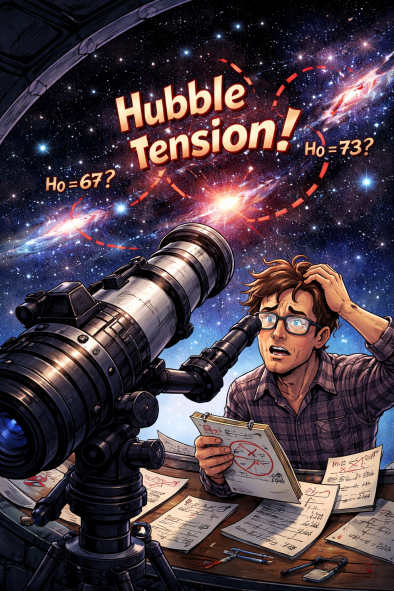
A newly published analysis proposes that the famous "Hubble tension" likely stems from an inference bias, occurring when standard General Relativity is applied to gravitational wave data that actually follows modified propagation.
HONOLULU - Californer -- The long-standing "Hubble tension"—a discrepancy between early-universe measurements of cosmic expansion and late-universe distance measurements—remains one of modern cosmology's most debated puzzles. While the discrepancy is often interpreted as evidence for new physics in the universe's expansion history, a new study proposes a different possibility: part of the tension may arise from how distances are inferred.
In a recent implications analysis, independent researcher Aiden B. Smith examines whether gravitational-wave distance measurements—specifically from so-called "dark sirens"—could be subtly affected by assumptions about how gravitational waves propagate across cosmological distances.
More on The Californer
Dark sirens are gravitational-wave events without confirmed electromagnetic counterparts. Their distances are inferred statistically using galaxy catalogues. Smith's analysis uses his previously identified propagation anomaly in the GWTC-3 dataset as a template and asks: if gravitational-wave amplitudes decay slightly differently than predicted by General Relativity, what effect would that have on cosmological inference?
The study finds that, under this hypothesis, applying standard General Relativity during distance compression can induce a shift in the inferred Hubble constant of approximately +2 to +5 km/s/Mpc—comparable in scale to the observed tension.
Importantly, the paper does not claim to resolve the Hubble tension. Instead, it demonstrates that gravitational-wave propagation assumptions are not mathematically neutral: if even modest deviations are present, they can bias late-time inferences.
The modified-propagation preference identified in the GWTC-3 dark-siren sample has been subjected to internal calibration and stress testing, including injection-based null simulations and robustness checks against selection and catalog perturbations. While the signal remains statistically unusual within the tested framework, confirming its physical origin will require independent replication and larger gravitational-wave samples from future observing runs.
More on The Californer
If confirmed, the results would suggest that part of the Hubble tension may reflect a subtle distance-inference effect rather than a fundamental breakdown of the expansion model itself. If not, the analysis provides a quantitative diagnostic of where dark-siren cosmology may be vulnerable to systematic effects.
The full study and reproducibility materials are publicly available.
Data and Study Availability: While the work is currently in peer review, the full study is available to read on Smith's research journal at quasardipolephenomenon.org. All code and reproducibility artifacts associated with this analysis can be downloaded via Zenodo (DOI: 10.5281/zenodo.18635659) or accessed on GitHub.
In a recent implications analysis, independent researcher Aiden B. Smith examines whether gravitational-wave distance measurements—specifically from so-called "dark sirens"—could be subtly affected by assumptions about how gravitational waves propagate across cosmological distances.
More on The Californer
- Rachel Farris Named to Forbes 2026 Best-In-State CPAs List
- Promoting Health One Item at a Time
- Ali Uyanik Joins Snell & Wilmer Palo Alto Office as Counsel
- Long Beach: City Announces Second Round of Backyard Builders Loan Program to Help Lower-Income Homeowners Build ADUs
- National Award: Workforce Development Board Ventura County Honored with 2026 WIOA Trailblazer Award
Dark sirens are gravitational-wave events without confirmed electromagnetic counterparts. Their distances are inferred statistically using galaxy catalogues. Smith's analysis uses his previously identified propagation anomaly in the GWTC-3 dataset as a template and asks: if gravitational-wave amplitudes decay slightly differently than predicted by General Relativity, what effect would that have on cosmological inference?
The study finds that, under this hypothesis, applying standard General Relativity during distance compression can induce a shift in the inferred Hubble constant of approximately +2 to +5 km/s/Mpc—comparable in scale to the observed tension.
Importantly, the paper does not claim to resolve the Hubble tension. Instead, it demonstrates that gravitational-wave propagation assumptions are not mathematically neutral: if even modest deviations are present, they can bias late-time inferences.
The modified-propagation preference identified in the GWTC-3 dark-siren sample has been subjected to internal calibration and stress testing, including injection-based null simulations and robustness checks against selection and catalog perturbations. While the signal remains statistically unusual within the tested framework, confirming its physical origin will require independent replication and larger gravitational-wave samples from future observing runs.
More on The Californer
- Southland Symphony Orchestra Celebrates Season Finale with Dvořák, Brahms, and Guest Cellist Ruslan Biryukov
- Whenever you face a Crisis PR situation, here are some very important tips for handling Crisis PR
- DivX® Launches Updated Guide to Free, High-Quality Video Conversion
- Lawyers Realty Group Stops Imminent Reverse Mortgage Foreclosure for Irvine Heirs
- Contracting Resources Group and Aalis Management Consulting Launch ARG Joint Venture Under SBA Mentor-Protégé Program
If confirmed, the results would suggest that part of the Hubble tension may reflect a subtle distance-inference effect rather than a fundamental breakdown of the expansion model itself. If not, the analysis provides a quantitative diagnostic of where dark-siren cosmology may be vulnerable to systematic effects.
The full study and reproducibility materials are publicly available.
Data and Study Availability: While the work is currently in peer review, the full study is available to read on Smith's research journal at quasardipolephenomenon.org. All code and reproducibility artifacts associated with this analysis can be downloaded via Zenodo (DOI: 10.5281/zenodo.18635659) or accessed on GitHub.
Source: Aiden Blake Smith
Filed Under: Science
0 Comments
Latest on The Californer
- Acuvance Appoints Sandeep Sabharwal to Board of Directors, Strengthening Leadership to Support Continued Platform Growth
- Navy Veteran Austen Alexander Builds Five Companies, Now Using AI to Help Fellow Vet Entrepreneurs
- Career Expert Reveals Top Resume Mistakes Job seekers Still Make
- Grange Insurance Association to Rebrand as Granwest Insurance on July 1, 2026
- Dr. Rosendo Icochea, MD Recognized for Contributions to Surgical Education and Medical Research
- Netberg SONiC 202511.n0: Powering Next-Level Performance, Security, and AI-Ready Networks
- Giftella Launches AI Gift-Finder App That Replaces Guesswork With Personalized Picks in Seconds
- Local Hauling Company Helps Landlords Fight Back
- Disabled Eaton Fire Survivor Calls for Review of Alleged Housing Retaliation and Discrimination
- Beverly.io Announces Nationwide Expansion and Poppins Payroll Partnership for Families
- GLOBAL EXCLUSIVE: Asim Azhar Breaks Silence on Global Transformation in First U.S. Cover Feature
- Award-Winning Author Dr. M.J. Duffy to Speak at the 2026 30th Annual Black Writers On Tour + Business + AI Expo
- Governor Newsom issues proclamation setting special election for California Congressional District 14
- New Vendor Registration to IAB Europe's Transparency and Consent Framework
- Interpreters Unlimited Debuts AI Assistants to Enhance Customer and Linguist Experience
- As Billions of Dollars Flood Into AI, Rorq sees its Achilles Heel the Market Isn't Pricing
- Stellar Winery Lineup to Pour at 38th Annual Ojai Wine Festival
- New Book: The Battle for Truth and Shadows - Guardians of Light - Epic Fantasy Unveils a War Between Light and Deception
- Clash of Prompts: The World's First AI Prompt Battle Royale
- California: Governor Newsom announces the latest digital technology at the DMV to fight identity fraud and reduce wait times