Trending...
- Dynamic Dachshund Dog Goes Global: Remember Point Launches a New Bilingual Children's Book - 179
- Cover Story about Matthew Cossolotto – Author of Harness Your PromisePower -- Published in July 2026 Enterprise World Magazine
- Long Beach Point in Time Count Shows Fewer People Experiencing Unsheltered Homelessness Despite Slight Rise in Homelessness

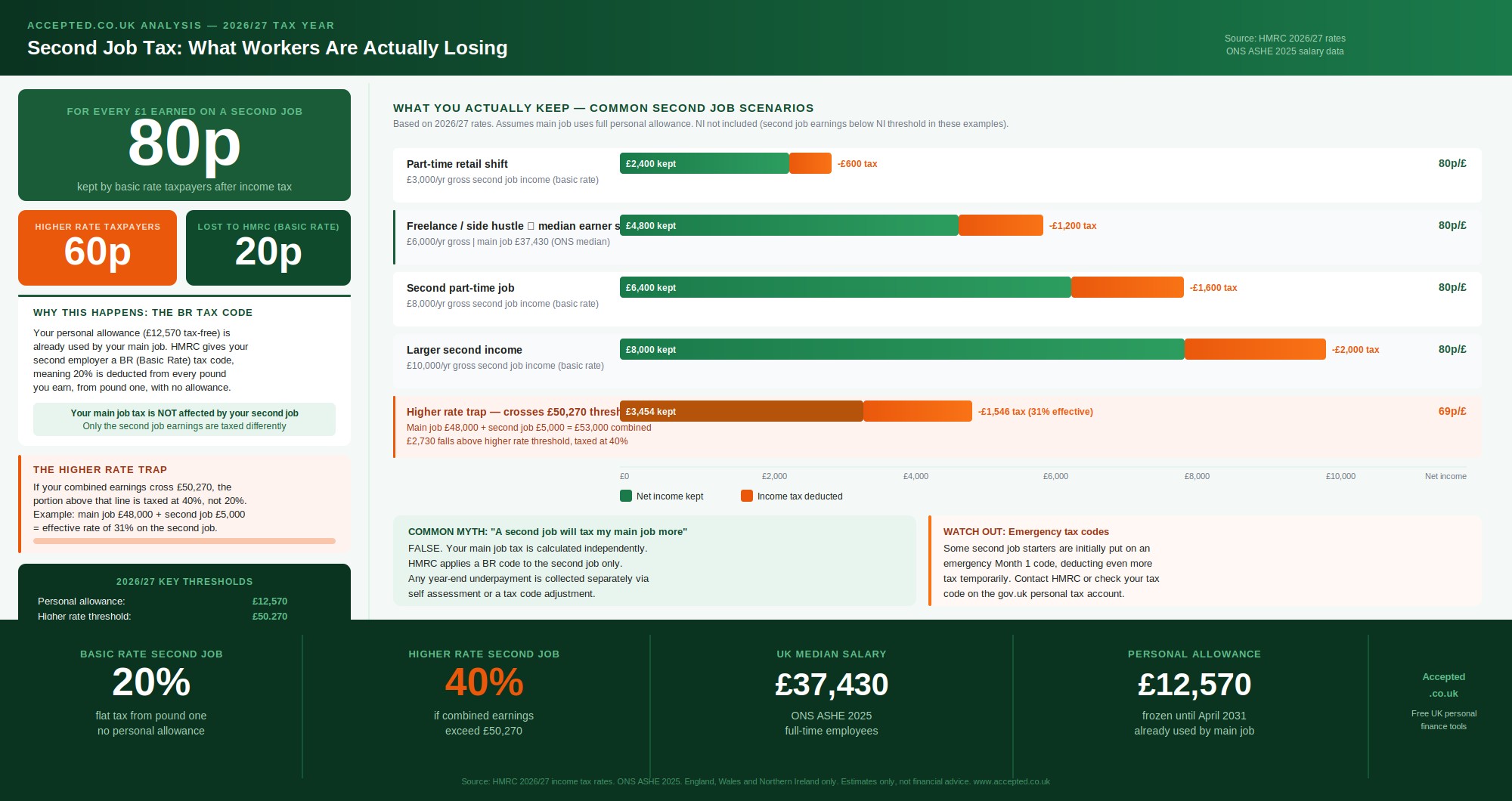

Research by free financial tools site Accepted.co.uk has calculated what workers with a second job actually take home after tax, revealing that the typical second-job earner loses 20p in every pound to HMRC before they see a penny, with those pushed into the higher rate band losing up to 40p in every pound.
BRAMHALL, STOCKPORT, U.K. - Californer -- Analysis by Accepted.co.uk, using 2026/27 income tax and National Insurance rates, has modelled the real take-home pay from a second job across a range of common earnings scenarios, from part-time retail shifts to freelance side hustles.
The research finds that a worker on the UK's median full-time salary of £37,430 who takes on a second job earning £6,000 a year, the equivalent of roughly two shifts a week in retail or hospitality, will lose £1,200 of that to income tax before they receive a penny. That leaves them with £4,800, or 80p for every pound earned. The position worsens for anyone whose combined earnings from both jobs push them above the £50,270 higher rate threshold. At that point, every additional pound earned on the second job is taxed at 40 per cent rather than 20 per cent, leaving higher rate workers with just 60p in the pound.
The confusion stems from how HMRC codes second jobs. Because the personal allowance, the £12,570 of earnings on which no income tax is paid, is already allocated to the main job, a second employer is instructed to apply a BR tax code. BR stands for basic rate and means a flat 20 per cent is deducted from every pound of second job income from the very first pound, with no tax-free allowance applied. Workers who are initially put on an emergency tax code can find themselves temporarily losing even more until the code is corrected.
More on The Californer
David Morris, Personal Finance Editor at Accepted.co.uk, commented: "A lot of people take on a second job expecting to keep most of what they earn, then get a nasty surprise when they see their first payslip. Twenty per cent off the top from pound one is a real shock when you are used to a personal allowance absorbing the first £12,570. The BR code is correct, but it catches people off guard every time."
The analysis also highlights a threshold trap affecting workers on higher salaries. Someone earning £48,000 in their main job who takes on a second role paying £5,000 will see their combined income reach £53,000, pulling £2,730 above the higher rate threshold of £50,270. The portion of second job income that crosses that line is taxed at 40 per cent rather than 20 per cent, meaning the effective tax rate across the full second job is around 31 per cent rather than the flat 20 per cent many would assume.
The research comes as more British workers than at any point in the past decade are taking on additional employment to manage rising living costs. HMRC data shows second job registrations have increased significantly since 2022, with an estimated 1.2 million workers now holding more than one employment simultaneously.
One common misconception the analysis addresses is the fear that taking a second job will increase the tax paid on the main job. This does not happen. Income tax is assessed across all income at the end of the tax year, but the main job itself is not retrospectively taxed more heavily because of second job earnings. Only the second job income is affected by the loss of the personal allowance.
More on The Californer
Data source and methodology: All tax calculations are based on confirmed 2026/27 income tax rates and thresholds for England, Wales and Northern Ireland. Personal allowance £12,570, basic rate 20 per cent on earnings from £12,571 to £50,270, higher rate 40 per cent above £50,270. Employee National Insurance: 8 per cent on earnings between £12,570 and £50,270, 2 per cent above. National Insurance is assessed per employment and does not accumulate across jobs in the same way as income tax. UK median full-time salary figure (£37,430) is sourced from the ONS Annual Survey of Hours and Earnings (ASHE) 2025, published November 2025. Scotland operates separate income tax bands and rates; figures in this release apply to England, Wales and Northern Ireland only.
Scope: Calculations assume no pension contributions, student loan deductions, benefits in kind, or other adjustments to taxable income. Results are estimates and individual circumstances will vary.
About: Accepted.co.uk is a free UK personal finance information and tools site offering 24 calculators and 40+ editorial guides across tax, mortgages, credit, savings, and business finance. The site carries no paywalls, advertising, or sponsored content. Readers can calculate their own second job take-home pay using the free Two Jobs Tax Calculator at
Media contact: David Morris, dave@accepted.co.uk
Disclaimer: The figures in this release are estimates based on publicly available tax rates and average earnings data. They do not constitute financial or tax advice. Individual circumstances vary and readers should consult a qualified adviser or use HMRC's own tools before making decisions.
The research finds that a worker on the UK's median full-time salary of £37,430 who takes on a second job earning £6,000 a year, the equivalent of roughly two shifts a week in retail or hospitality, will lose £1,200 of that to income tax before they receive a penny. That leaves them with £4,800, or 80p for every pound earned. The position worsens for anyone whose combined earnings from both jobs push them above the £50,270 higher rate threshold. At that point, every additional pound earned on the second job is taxed at 40 per cent rather than 20 per cent, leaving higher rate workers with just 60p in the pound.
The confusion stems from how HMRC codes second jobs. Because the personal allowance, the £12,570 of earnings on which no income tax is paid, is already allocated to the main job, a second employer is instructed to apply a BR tax code. BR stands for basic rate and means a flat 20 per cent is deducted from every pound of second job income from the very first pound, with no tax-free allowance applied. Workers who are initially put on an emergency tax code can find themselves temporarily losing even more until the code is corrected.
More on The Californer
- SWENSON Completes Landmark Big Wave Center
- Casino M8trix Expands Community Investment Through AACSA Partnership
- TCN Vending USA Expands with 5 Strategic U.S. Warehouses for Coast-to-Coast Fast Delivery
- Salestrics Releases Version 2.0 to Unify CRM, Business Email, and Operations on a Single Customer Graph
- ForityCloud Launches Tandem, a Fully Managed Private Cloud for Businesses Ready to Scale
David Morris, Personal Finance Editor at Accepted.co.uk, commented: "A lot of people take on a second job expecting to keep most of what they earn, then get a nasty surprise when they see their first payslip. Twenty per cent off the top from pound one is a real shock when you are used to a personal allowance absorbing the first £12,570. The BR code is correct, but it catches people off guard every time."
The analysis also highlights a threshold trap affecting workers on higher salaries. Someone earning £48,000 in their main job who takes on a second role paying £5,000 will see their combined income reach £53,000, pulling £2,730 above the higher rate threshold of £50,270. The portion of second job income that crosses that line is taxed at 40 per cent rather than 20 per cent, meaning the effective tax rate across the full second job is around 31 per cent rather than the flat 20 per cent many would assume.
The research comes as more British workers than at any point in the past decade are taking on additional employment to manage rising living costs. HMRC data shows second job registrations have increased significantly since 2022, with an estimated 1.2 million workers now holding more than one employment simultaneously.
One common misconception the analysis addresses is the fear that taking a second job will increase the tax paid on the main job. This does not happen. Income tax is assessed across all income at the end of the tax year, but the main job itself is not retrospectively taxed more heavily because of second job earnings. Only the second job income is affected by the loss of the personal allowance.
More on The Californer
- Wrapbook Announces Webinar on Film and TV Tax Incentives
- City of Long Beach Extends Heat Alert, Activates Additional Cooling Centers on Sunday, July 26
- Aderra Opens in Magnolia, Texas, Offering a New Model for 62+ Homeownership
- Pervaziv AI Expands Cortex Enterprise AI with Salesforce CRM
- For American Artist Appreciation Month (August): Check out a painting and a poem by Robert M. Barrows called "GOT THOSE STARVING ARTIST BLUES?"
Data source and methodology: All tax calculations are based on confirmed 2026/27 income tax rates and thresholds for England, Wales and Northern Ireland. Personal allowance £12,570, basic rate 20 per cent on earnings from £12,571 to £50,270, higher rate 40 per cent above £50,270. Employee National Insurance: 8 per cent on earnings between £12,570 and £50,270, 2 per cent above. National Insurance is assessed per employment and does not accumulate across jobs in the same way as income tax. UK median full-time salary figure (£37,430) is sourced from the ONS Annual Survey of Hours and Earnings (ASHE) 2025, published November 2025. Scotland operates separate income tax bands and rates; figures in this release apply to England, Wales and Northern Ireland only.
Scope: Calculations assume no pension contributions, student loan deductions, benefits in kind, or other adjustments to taxable income. Results are estimates and individual circumstances will vary.
About: Accepted.co.uk is a free UK personal finance information and tools site offering 24 calculators and 40+ editorial guides across tax, mortgages, credit, savings, and business finance. The site carries no paywalls, advertising, or sponsored content. Readers can calculate their own second job take-home pay using the free Two Jobs Tax Calculator at
Media contact: David Morris, dave@accepted.co.uk
Disclaimer: The figures in this release are estimates based on publicly available tax rates and average earnings data. They do not constitute financial or tax advice. Individual circumstances vary and readers should consult a qualified adviser or use HMRC's own tools before making decisions.
Source: Accepted.co.uk
Filed Under: Financial
0 Comments
Latest on The Californer
- California sues to stop Trump from using public safety funding to pressure states on elections
- Long Beach Health Department to Host Back-to-School Vaccination and Resource Fair
- PODS Local Ramping Up Community Support for Manna Conejo Valley Food Bank Through July 31st
- California: Governor Newsom delivers $109.6 million in voter-approved Prop 1 funding for 278 supportive homes, including housing for veterans
- American Battery Company Celebrates 100th Anniversary With Senate Proclamation
- US Sourcing Mission to Vietnam from Sept. 02 to Sept. 06, 2026
- Decode Digital Works Appoints Leonard DiTomasso to Strategic Advisory Board
- SYOKAMI Announces Limited-Time Direct-to-Consumer Discount on Top-Ranked 7.7-Inch Meat Cleaver
- WeblineGlobal Identifies the Top 10 AI Skills Driving Enterprise Hiring in 2026
- Elevate Your Sneakers With Crep Protect Trek Laces
- Save the Date! Long Beach Shares Lineup for 15th Annual Uptown Jazz Festival
- Meet Privateer: Tucson's High-Tech Security Force Built With Paramilitary Precision
- Noir Vine Society Launches Black Business Month Initiative to Spotlight Black-Owned Wine Brands
- Equoria Systems Launches Enterprise Real Estate Equity Securities & Liquidity Infrastructure
- City of Long Beach Invites Youth to Apply for Youth Advisory Council
- California: Acting Governor Rivas proclaims Disability Pride Month
- Long Beach: Health Department to Distribute Free Firearm Safes to Promote Community Safety and Prevent Firearm-Related Injuries
- City of Long Beach Issues a Heat Alert and Advises Residents to Take Precautions Against Heat
- TEAM Referral Network San Diego Hosts Summer Celebration at The Heights Golf Club
- North Bay Grading and Paving Marks 15 Years, Expands U.S. Coast Guard Asphalt Project