Trending...
- Memelinked Social Media powered by cryptocurrency launching July 2026 - 282
- First Partner Jennifer Siebel Newsom launches California Love, California Strong to fight loneliness across the state
- Arcuri Group Announces Long‑Term Partnership with WakeMed Health & Hospitals to Deliver Situational Awareness and De‑escalation Training
Diversity of Ideas: U.S. Congressional Candidate Peter Coe Verbica Speaks Up as a Common-Sense, Fiscal Conservative
BAY AREA, Calif. - Californer -- "We don't have a trillion-dollar debt because we haven't taxed enough; we have a trillion-dollar debt because we spend too much."
― Ronald Reagan
California does not suffer from a shortage of revenue. It suffers from a shortage of accountability.
California and its municipalities are drowning in billions of dollars of unfunded pension and benefit liabilities — promises made by politicians that now come due.
Faced with these obligations and unwilling to reform the structures that created them, Sacramento and local governments have become ravenous in their search for new tax revenue. The result is a permanent upward ratchet of taxation.
This is not accidental. The lion's share of California's political class is financially and structurally compromised by the very interests that benefit from higher taxes: public-employee unions, litigation lobbies, and a constellation of special-interest groups that dominate campaign financing. Meaningful reform cannot emerge from within that system.
Only a statewide voter initiative — outside the influence of entrenched power — can halt California's accelerating tax spiral and return sovereignty to the people.
For decades, Sacramento has built one of the most complex, punitive, and opaque tax systems in America. The result is not good governance, but a quiet erosion of trust between citizens and the state. When taxes become incomprehensible, power slips from voters and settles permanently into the hands of politicians, lobbyists, and bureaucracies.
It is time for Californians to take that power back.
I am advocating for a statewide initiative that would enact a 6% flat income tax, a 4% flat sales tax, and — most importantly — permanently require voter approval for any future increase. This reform would not simply lower taxes; it would restore the moral foundation of taxation itself: consent of the governed.
The Broken Status Quo
California's tax burden did not become this heavy overnight.
When the state first adopted a sales tax in 1933, the rate was roughly 2.5%. Over the following decades it crept steadily upward — reaching 4% by the early 1960s, nearly 8% by the 1990s, and today the statewide base rate alone is 7.25%, with combined local rates regularly exceeding 9–10% in many communities.
More on The Californer
Income taxes have followed the same pattern of quiet expansion. What began as a relatively modest progressive structure has grown into the highest top marginal income tax in the nation — 13.3% today, rising to an effective 14.3% on income over $1 million when California's so-called "mental health" surcharge is included, before accounting for additional payroll taxes that further increase the real marginal burden on both workers and employers. Each increase may have been defended as temporary, targeted, or necessary, but the cumulative effect is unmistakable: Californians are carrying one of the heaviest tax burdens in America.
California's escalating tax burden has not occurred in a vacuum. It has produced visible consequences: a steady exodus of middle-class families and the relocation of major corporate headquarters and operations — including companies such as Intel, Chevron, Oracle, and Tesla, among others — to states offering stability, predictability, and respect for capital and labor. When productive citizens and high-quality employers leave, the tax base erodes, communities weaken, and Sacramento responds not with reform, but with still higher taxes on those who remain.
And yet, despite record revenues and rising tax rates, Sacramento's appetite only grows.
A Simple, Fair Alternative
Under the proposal:
Everyone pays the same 6% income tax.
Everyone pays the same 4% sales tax.
No increase is allowed without direct voter approval.
You earn — you pay 6%. You buy — you pay 4%. And Sacramento may not touch those rates without your vote.
This simplicity is not just efficient; it is just. The law would apply equally to all, restoring public confidence and dramatically reducing compliance costs for families and employers alike.
Returning Sovereignty to the People
This initiative is not merely about tax rates. It is about who governs California.
For too long, the Legislature has treated taxpayers as an unlimited credit card. Requiring voter approval for tax increases does something revolutionary in modern politics: it forces government to earn permission before taking more.
That is not radical. That is the American system.
Restoring Discipline at Every Level of Government
More on The Californer
This reform must apply not only to Sacramento, but also to local governments.
Today, cities and counties routinely impose quiet sales-tax increases of one-quarter or one-half of one percent through low-visibility ballot measures that receive little scrutiny and almost no public debate. These incremental hikes accumulate year after year, pushing the total tax burden ever higher while allowing politicians to claim that "the state" has not raised taxes.
Under this initiative, no state or local government in California would be permitted to raise income or sales tax rates without direct voter approval — and at the local level, such increases would require a true supermajority of voters.
This safeguard matters. Local tax elections are often dominated by highly organized public-sector interests with a direct financial stake in the outcome. A supermajority requirement ensures that any increase commands broad public consensus, not merely the momentum of well-funded special interests.
True reform means restoring fiscal discipline not only in the Capitol, but in every city hall and county office across the state.
Why It Will Work
Lower, predictable taxes will make California competitive again. Businesses will return. Investment will grow. Wages will rise. The tax base will expand — not through coercion, but through prosperity.
Most importantly, citizens will once again feel that government belongs to them.
A New Social Contract
California does not need higher taxes. It needs higher trust.
By adopting a flat, transparent tax system and restoring voter control over taxation, we can finally end the state of Taxifornia and begin building a government that serves its people rather than rules them.
The power of taxation belongs to the people. It is time they took it back.
End Complexity. End Confusion.
This reform will finally end the needless complexity and hidden costs that punish working families and small businesses every day. And if there is any resistance, it will come not from ordinary Californians, but from the tax-and-spend establishment in Sacramento and the special interests that profit from keeping the system broken. A simpler tax code costs less, works better, and belongs to the people.
For more information, please go to www.peterverbica.com
California needs change -- ideas like the 6% Solution. Let's get Peter Coe Verbica elected to Congress.
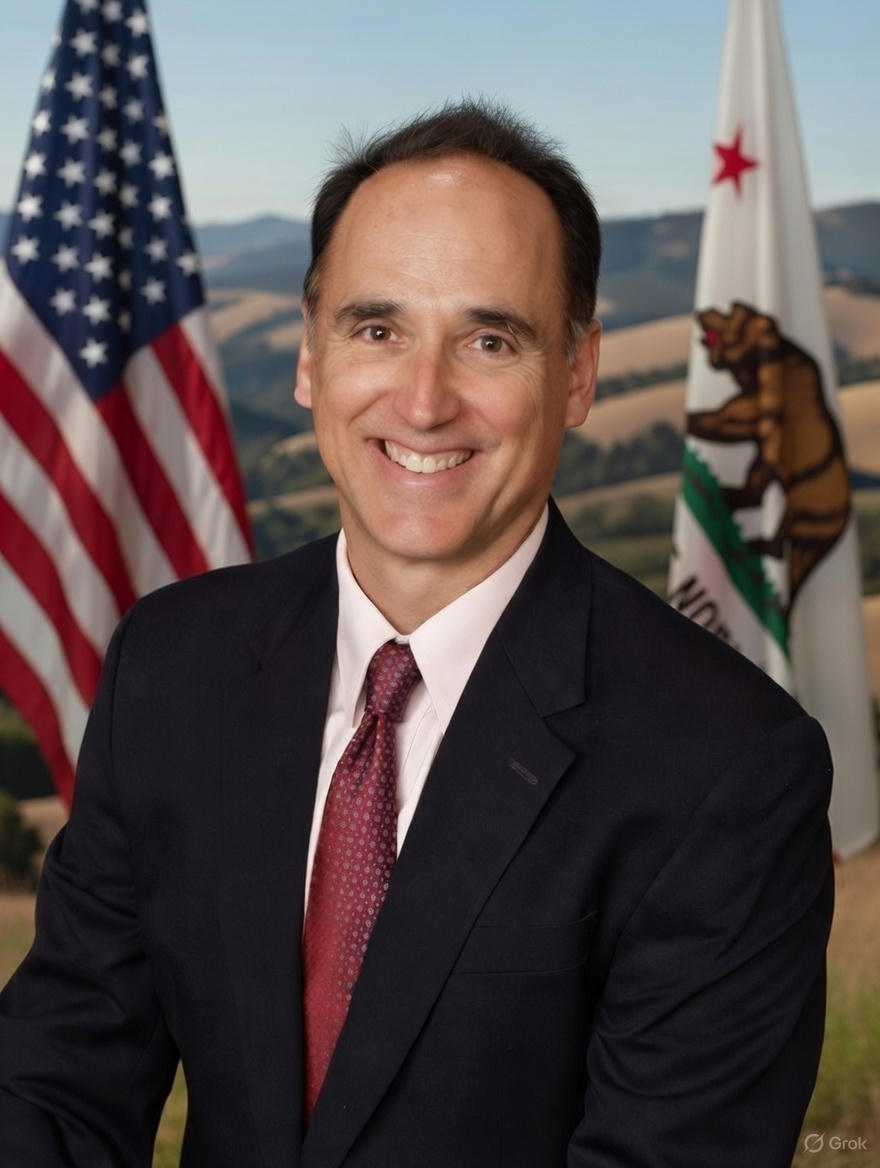
Northern California foothills, US and Flag in candidate rendering reimagined by Grok, 2026.
Paid for by Verbica for Congress.
― Ronald Reagan
California does not suffer from a shortage of revenue. It suffers from a shortage of accountability.
California and its municipalities are drowning in billions of dollars of unfunded pension and benefit liabilities — promises made by politicians that now come due.
Faced with these obligations and unwilling to reform the structures that created them, Sacramento and local governments have become ravenous in their search for new tax revenue. The result is a permanent upward ratchet of taxation.
This is not accidental. The lion's share of California's political class is financially and structurally compromised by the very interests that benefit from higher taxes: public-employee unions, litigation lobbies, and a constellation of special-interest groups that dominate campaign financing. Meaningful reform cannot emerge from within that system.
Only a statewide voter initiative — outside the influence of entrenched power — can halt California's accelerating tax spiral and return sovereignty to the people.
For decades, Sacramento has built one of the most complex, punitive, and opaque tax systems in America. The result is not good governance, but a quiet erosion of trust between citizens and the state. When taxes become incomprehensible, power slips from voters and settles permanently into the hands of politicians, lobbyists, and bureaucracies.
It is time for Californians to take that power back.
I am advocating for a statewide initiative that would enact a 6% flat income tax, a 4% flat sales tax, and — most importantly — permanently require voter approval for any future increase. This reform would not simply lower taxes; it would restore the moral foundation of taxation itself: consent of the governed.
The Broken Status Quo
California's tax burden did not become this heavy overnight.
When the state first adopted a sales tax in 1933, the rate was roughly 2.5%. Over the following decades it crept steadily upward — reaching 4% by the early 1960s, nearly 8% by the 1990s, and today the statewide base rate alone is 7.25%, with combined local rates regularly exceeding 9–10% in many communities.
More on The Californer
- JiT Home Buyers Explains the 70% Rule Investors Use When Evaluating Residential Properties
- White Glove Restoration Performs HAZWOPER-Certified Hazardous Waste Cleanup & Emergency Response in Downtown San Diego
- Simpalm Staffing Services Launched its Refreshed Website for Remote Staffing Services
- Claude Riveloux Review 2026: How the $10B Fund Manager Dispels 'Scam' Rumors Through Education
- Pure Energy Electrical Services, LLC Announces Strong Start to 2026, Reinforcing Customer-First Electrical Service Across Northeast Florida
Income taxes have followed the same pattern of quiet expansion. What began as a relatively modest progressive structure has grown into the highest top marginal income tax in the nation — 13.3% today, rising to an effective 14.3% on income over $1 million when California's so-called "mental health" surcharge is included, before accounting for additional payroll taxes that further increase the real marginal burden on both workers and employers. Each increase may have been defended as temporary, targeted, or necessary, but the cumulative effect is unmistakable: Californians are carrying one of the heaviest tax burdens in America.
California's escalating tax burden has not occurred in a vacuum. It has produced visible consequences: a steady exodus of middle-class families and the relocation of major corporate headquarters and operations — including companies such as Intel, Chevron, Oracle, and Tesla, among others — to states offering stability, predictability, and respect for capital and labor. When productive citizens and high-quality employers leave, the tax base erodes, communities weaken, and Sacramento responds not with reform, but with still higher taxes on those who remain.
And yet, despite record revenues and rising tax rates, Sacramento's appetite only grows.
A Simple, Fair Alternative
Under the proposal:
Everyone pays the same 6% income tax.
Everyone pays the same 4% sales tax.
No increase is allowed without direct voter approval.
- No loopholes.
- No special interests.
- No late-night legislative maneuvers.
You earn — you pay 6%. You buy — you pay 4%. And Sacramento may not touch those rates without your vote.
This simplicity is not just efficient; it is just. The law would apply equally to all, restoring public confidence and dramatically reducing compliance costs for families and employers alike.
Returning Sovereignty to the People
This initiative is not merely about tax rates. It is about who governs California.
For too long, the Legislature has treated taxpayers as an unlimited credit card. Requiring voter approval for tax increases does something revolutionary in modern politics: it forces government to earn permission before taking more.
That is not radical. That is the American system.
Restoring Discipline at Every Level of Government
More on The Californer
- Emerald Vault, a Digital Provenance Infrastructure Designed to Protect Artwork
- Pervaziv AI Announces Cortex 2.5 to Advance Enterprise AI, Developer Tools and Cybersecurity
- Danholm Collection Launches Boutique Luxury Real Estate Brokerage in Central Florida
- Avocado Oil, A Natual Monounsaturated oil (fat) for cooking and salad, Dr.Abhay Kumar Pati, CA USA
- Wooffy Introduces a Scalable Design Strategy for Modern Pet Living
This reform must apply not only to Sacramento, but also to local governments.
Today, cities and counties routinely impose quiet sales-tax increases of one-quarter or one-half of one percent through low-visibility ballot measures that receive little scrutiny and almost no public debate. These incremental hikes accumulate year after year, pushing the total tax burden ever higher while allowing politicians to claim that "the state" has not raised taxes.
Under this initiative, no state or local government in California would be permitted to raise income or sales tax rates without direct voter approval — and at the local level, such increases would require a true supermajority of voters.
This safeguard matters. Local tax elections are often dominated by highly organized public-sector interests with a direct financial stake in the outcome. A supermajority requirement ensures that any increase commands broad public consensus, not merely the momentum of well-funded special interests.
- No end-runs.
- No shell games.
- No shifting of responsibility.
True reform means restoring fiscal discipline not only in the Capitol, but in every city hall and county office across the state.
Why It Will Work
Lower, predictable taxes will make California competitive again. Businesses will return. Investment will grow. Wages will rise. The tax base will expand — not through coercion, but through prosperity.
Most importantly, citizens will once again feel that government belongs to them.
A New Social Contract
California does not need higher taxes. It needs higher trust.
By adopting a flat, transparent tax system and restoring voter control over taxation, we can finally end the state of Taxifornia and begin building a government that serves its people rather than rules them.
The power of taxation belongs to the people. It is time they took it back.
End Complexity. End Confusion.
This reform will finally end the needless complexity and hidden costs that punish working families and small businesses every day. And if there is any resistance, it will come not from ordinary Californians, but from the tax-and-spend establishment in Sacramento and the special interests that profit from keeping the system broken. A simpler tax code costs less, works better, and belongs to the people.
For more information, please go to www.peterverbica.com
California needs change -- ideas like the 6% Solution. Let's get Peter Coe Verbica elected to Congress.
Northern California foothills, US and Flag in candidate rendering reimagined by Grok, 2026.
Paid for by Verbica for Congress.
Source: U.S. Congressional Candidate Peter Coe Verbica
0 Comments
Latest on The Californer
- FREE MONEY FOR COLLEGE: New effort connects California community college students with available CalKIDS scholarships
- Pregis Expands Wind Energy Use, Advancing Progress Toward Net Zero by 2040
- Orange County's Warm Homes Attract Unwelcome Guests as Rodents Escape Cold
- California sues Trump over his unlawful use of tariffs — again
- Dr. Sheel Desai Solomon and Preston Dermatology Continue Awards Streak with Top Honors in 2026 Maggy Awards
- HeapHero Shares Java Heap Sizing Best Practices: Choosing the Right -Xms and -Xmx Parameters
- JiT Home Buyers Discusses Growing Challenges of Vacant Homes Across U.S. Housing Markets
- Jack and Sage Acquires Sustainable Apparel Brand Kastlfel, Expanding Premium Logo Wear Across National Parks and Ski Resorts
- Beau Jest at North Coast Repertory Theatre
- Cancun International Airport Prepares for Record Travel Surge Ahead of Spring Break, Summer, and the 2026 High Season
- $167 Billion Pharma R&D Market Largely Untapped by AI Creates Major Growth Runway for KALA Bios Data-Sovereign AI Strategy: N A S D A Q: KALA
- Lighthouse Tech Awards Recognize Top HR Technology Providers for 2026
- ADB Selects OneVizion to Advance Field Execution and Infrastructure Program Management
- California: Governor Newsom and Acting Governor Kounalakis honor fallen Chief Warrant Officer Three Robert M. Marzan
- Memelinked Social Media powered by cryptocurrency launching July 2026
- Ventura College Foundation Honors 15 "Pirates of Distinction," Launches "Invest in Success"
- City of Long Beach Announces Departure of Director of Technology and Innovation Department
- Seven-Year-Old Toronto Dancer Julianna Selivanov Wins Nine Medals at Quebec Championship and Reaches Finals at UK Dance Festival
- Alexander Rossi and Mayor Bob Foster to be Inducted into 20th Anniversary Long Beach Motorsports Walk of Fame
- California: Governor Newsom orders flags at half-staff as Reverend Jesse Jackson laid to rest