Trending...
- Eddy Corp and SMAART POWER LLC Announce Strategic Teaming Agreement to Accelerate Microgrid and Distributed Energy Deployments - 259
- California: Governor Newsom expands film and TV tax credits with new legislation, creates tax credit to support post-production jobs - 188
- Governor Newsom signs bill expanding fuel options to help Californians save at the pump, amid Donald Trump's gas price crisis - 139
Download
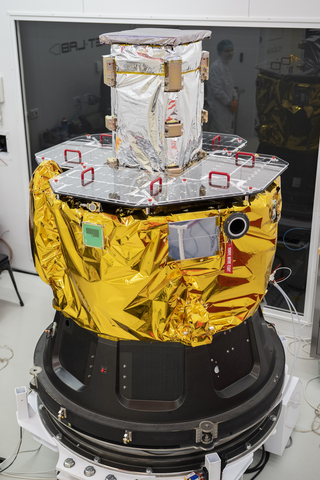
Rocket Lab Lunar Photon Spacecraft with CAPSTONE Satellite Integrated (Photo: Business Wire)
LONG BEACH, Calif.--(BUSINESS WIRE)--Rocket Lab USA, Inc. (Nasdaq: RKLB) ("Rocket Lab" or "the Company"), a leading launch and space systems company, today announced it has successfully deployed a pathfinding satellite for NASA, setting it on a course to the Moon. The deployment marks the successful completion of Rocket Lab's first deep space mission, paving the way for the Company's upcoming interplanetary missions to Mars and Venus.
Owned and operated by Advanced Space on behalf of NASA, the Cislunar Autonomous Positioning System Technology Operations and Navigation Experiment (CAPSTONE) will be the first spacecraft to test the Near Rectilinear Halo Orbit (NRHO) around the Moon. This is the same orbit intended for NASA's Gateway, a Moon-orbiting outpost that will provide essential support for long-term astronaut lunar missions as part of the Artemis program.
More on The Californer
Rocket Lab's role in the mission took place over two phases. First, CAPSTONE was successfully launched to low Earth orbit by Rocket Lab's Electron launch vehicle on June 28th. From there, Rocket Lab's Lunar Photon spacecraft provided in-space transportation, power, and communications to CAPSTONE. After six days of orbit-raising burns by Lunar Photon's 3D printed HyperCurie engine, CAPSTONE was deployed on its ballistic lunar transfer trajectory to the Moon as planned at 07:18 UTC on July 4th. The mission was Rocket Lab's fourth Electron launch this year, demonstrating the rocket's continued reliability. In addition to providing the launch, Rocket Lab designed, manufactured, and operated the Lunar Photon spacecraft, successfully completing a highly complex deep space mission and demonstrating Rocket Lab's growing capabilities as an end-to-end space company.
"The CAPSTONE mission marks the beginning of humanity's return to the Moon through NASA's Artemis program and we're incredibly proud that Rocket Lab has played a key role in that," said Rocket Lab founder and CEO, Peter Beck. "The Rocket Lab team has been working on CAPSTONE with NASA and our mission partners for more than two years, developing new small satellite technology in the form of the Lunar Photon spacecraft to make this mission possible, so it's an incredible feeling after all that hard work and innovation to achieve mission success and set CAPSTONE on a course for the Moon. This has been Rocket Lab's most complex mission to date and our team has been incredible. We pushed Electron and Photon to their limits and proved it's possible to do big missions with small spacecraft. Now we'll be applying this ground-breaking technology for more interplanetary journeys, including our upcoming missions to Venus and Mars."
With Rocket Lab's role in the mission now complete, CAPSTONE's solo journey to the Moon has begun. CAPSTONE will use its own propulsion and the Sun's gravity to navigate the rest of the way to the Moon, a four-month journey that will have CAPSTONE arriving to its lunar orbit on November 13, 2022. The gravity-driven track will dramatically reduce the amount of fuel the CubeSat needs to get to the Moon. Advanced Space and Terran Orbital will manage the operation of the CAPSTONE satellite for the duration of its orbital lifespan.
The CAPSTONE mission was Rocket Lab's 27th Electron launch overall, but it featured several significant technological firsts for the Company, including:
CAPSTONE was the first in a series of interplanetary missions for Rocket Lab's Photon spacecraft, including the ESCAPADE mission to Mars in 2024 and Rocket Lab's upcoming private mission to Venus.
More on The Californer
Advanced Space of Colorado, a leading commercial space solutions company, owns the CAPSTONE satellite and operates the mission. CAPSTONE was designed and built by Terran Orbital. CAPSTONE development is supported by NASA's Space Technology Mission Directorate via the Small Spacecraft Technology Program at NASA's Ames Research Center in California's Silicon Valley. Advanced Exploration Systems within NASA's Human Exploration and Operations Mission Directorate supports the launch and mission operations. NASA's Launch Services Program at Kennedy Space Center in Florida is responsible for launch management.
+ Images & Video Content
https://flic.kr/s/aHBqjzPrHL
+ About Rocket Lab
Founded in 2006, Rocket Lab is an end-to-end space company with an established track record of mission success. We deliver reliable launch services, satellite manufacture, spacecraft components, and on-orbit management solutions that make it faster, easier and more affordable to access space. Headquartered in Long Beach, California, Rocket Lab designs and manufactures the Electron small orbital launch vehicle and the Photon satellite platform and is developing the Neutron 8-ton payload class launch vehicle. Since its first orbital launch in January 2018, Rocket Lab's Electron launch vehicle has become the second most frequently launched U.S. rocket annually and has delivered 147 satellites to orbit for private and public sector organizations, enabling operations in national security, scientific research, space debris mitigation, Earth observation, climate monitoring, and communications. Rocket Lab's Photon spacecraft platform has been selected to support NASA missions to the Moon and Mars, as well as the first private commercial mission to Venus. Rocket Lab has three launch pads at two launch sites, including two launch pads at a private orbital launch site located in New Zealand and a second launch site in Virginia, USA which is expected to become operational in 2022. To learn more, visit www.rocketlabusa.com.
Contacts
+ Rocket Lab Media Contact
Morgan Bailey
media@rocketlabusa.com
0) { // Create container for hi-res image jQuery('#bw-release-hires').append('
'); }; }); ]]>
Social Media Profiles
Contacts
+ Rocket Lab Media Contact
Morgan Bailey
media@rocketlabusa.com


Rocket Lab Lunar Photon Spacecraft with CAPSTONE Satellite Integrated (Photo: Business Wire)
- Rocket Lab Lunar Photon Spacecraft with CAPSTONE Satellite Integrated (Photo: Business Wire)



LONG BEACH, Calif.--(BUSINESS WIRE)--Rocket Lab USA, Inc. (Nasdaq: RKLB) ("Rocket Lab" or "the Company"), a leading launch and space systems company, today announced it has successfully deployed a pathfinding satellite for NASA, setting it on a course to the Moon. The deployment marks the successful completion of Rocket Lab's first deep space mission, paving the way for the Company's upcoming interplanetary missions to Mars and Venus.
Owned and operated by Advanced Space on behalf of NASA, the Cislunar Autonomous Positioning System Technology Operations and Navigation Experiment (CAPSTONE) will be the first spacecraft to test the Near Rectilinear Halo Orbit (NRHO) around the Moon. This is the same orbit intended for NASA's Gateway, a Moon-orbiting outpost that will provide essential support for long-term astronaut lunar missions as part of the Artemis program.
More on The Californer
- Governor Newsom signs legislation supporting California Native AmericansGovernor Newsom signs legislation supporting California Native Americans
- California: Governor Newsom proclaims Native American Day
- ASN Software Introduces New California CARS Act Dealer Updates
- USA Air Management Marks 30 Years of Air Duct Cleaning in NJ Urges Homeowners to Schedule Dryer Vent Cleaning Before Heating Season
- Dr. Jay Johannigman Returns to Cincinnati Following 46 Years of Military Service
Rocket Lab's role in the mission took place over two phases. First, CAPSTONE was successfully launched to low Earth orbit by Rocket Lab's Electron launch vehicle on June 28th. From there, Rocket Lab's Lunar Photon spacecraft provided in-space transportation, power, and communications to CAPSTONE. After six days of orbit-raising burns by Lunar Photon's 3D printed HyperCurie engine, CAPSTONE was deployed on its ballistic lunar transfer trajectory to the Moon as planned at 07:18 UTC on July 4th. The mission was Rocket Lab's fourth Electron launch this year, demonstrating the rocket's continued reliability. In addition to providing the launch, Rocket Lab designed, manufactured, and operated the Lunar Photon spacecraft, successfully completing a highly complex deep space mission and demonstrating Rocket Lab's growing capabilities as an end-to-end space company.
"The CAPSTONE mission marks the beginning of humanity's return to the Moon through NASA's Artemis program and we're incredibly proud that Rocket Lab has played a key role in that," said Rocket Lab founder and CEO, Peter Beck. "The Rocket Lab team has been working on CAPSTONE with NASA and our mission partners for more than two years, developing new small satellite technology in the form of the Lunar Photon spacecraft to make this mission possible, so it's an incredible feeling after all that hard work and innovation to achieve mission success and set CAPSTONE on a course for the Moon. This has been Rocket Lab's most complex mission to date and our team has been incredible. We pushed Electron and Photon to their limits and proved it's possible to do big missions with small spacecraft. Now we'll be applying this ground-breaking technology for more interplanetary journeys, including our upcoming missions to Venus and Mars."
With Rocket Lab's role in the mission now complete, CAPSTONE's solo journey to the Moon has begun. CAPSTONE will use its own propulsion and the Sun's gravity to navigate the rest of the way to the Moon, a four-month journey that will have CAPSTONE arriving to its lunar orbit on November 13, 2022. The gravity-driven track will dramatically reduce the amount of fuel the CubeSat needs to get to the Moon. Advanced Space and Terran Orbital will manage the operation of the CAPSTONE satellite for the duration of its orbital lifespan.
The CAPSTONE mission was Rocket Lab's 27th Electron launch overall, but it featured several significant technological firsts for the Company, including:
- First deep space mission.
- First use of Lunar Photon, a high energy variant of the Rocket Lab-designed and built Photon spacecraft. Rocket Lab previously launched and continues to operate two low Earth orbit variants of the Photon spacecraft.
- First collaborative mission between Rocket Lab and Advanced Solutions Inc, a Colorado-based flight-software company acquired by Rocket Lab in late 2021.
- First time using the FR-lite satellite radio which Rocket Lab has an exclusive license agreement with Johns Hopkins University Applied Physics Laboratory to manufacture.
- First mission where Electron's second stage deorbited the same day as launch.
- First mission planning and executing lunar trajectories.
- At 300 kg (661 lbs) of payload mass, the mission was Electron's heaviest lift to date.
CAPSTONE was the first in a series of interplanetary missions for Rocket Lab's Photon spacecraft, including the ESCAPADE mission to Mars in 2024 and Rocket Lab's upcoming private mission to Venus.
More on The Californer
- California: Governor Newsom signs "Braun's Law," and package of bills to crack down on DUI offenders
- Allstream Energy Partners, SEO Experts in Oil and Gas, Awarded Gas Processing OEM Agreement
- Governor Newsom signs bills to keep strengthening security and safe access for California's faith and nonprofit communities
- Growth Story Expands: $54.6M Contract, $30M Revenue Run Rate, 800+ Customers, 50+ Patents & New AI Cybersecurity Products for Cycurion, Inc $CYCU
- Sky Quarry Restarts Nevada's Only Crude Oil Refinery — A Major New Chapter Begins in This Highly Lucrative sector for N A S D A Q: SKYQ
Advanced Space of Colorado, a leading commercial space solutions company, owns the CAPSTONE satellite and operates the mission. CAPSTONE was designed and built by Terran Orbital. CAPSTONE development is supported by NASA's Space Technology Mission Directorate via the Small Spacecraft Technology Program at NASA's Ames Research Center in California's Silicon Valley. Advanced Exploration Systems within NASA's Human Exploration and Operations Mission Directorate supports the launch and mission operations. NASA's Launch Services Program at Kennedy Space Center in Florida is responsible for launch management.
+ Images & Video Content
https://flic.kr/s/aHBqjzPrHL
+ About Rocket Lab
Founded in 2006, Rocket Lab is an end-to-end space company with an established track record of mission success. We deliver reliable launch services, satellite manufacture, spacecraft components, and on-orbit management solutions that make it faster, easier and more affordable to access space. Headquartered in Long Beach, California, Rocket Lab designs and manufactures the Electron small orbital launch vehicle and the Photon satellite platform and is developing the Neutron 8-ton payload class launch vehicle. Since its first orbital launch in January 2018, Rocket Lab's Electron launch vehicle has become the second most frequently launched U.S. rocket annually and has delivered 147 satellites to orbit for private and public sector organizations, enabling operations in national security, scientific research, space debris mitigation, Earth observation, climate monitoring, and communications. Rocket Lab's Photon spacecraft platform has been selected to support NASA missions to the Moon and Mars, as well as the first private commercial mission to Venus. Rocket Lab has three launch pads at two launch sites, including two launch pads at a private orbital launch site located in New Zealand and a second launch site in Virginia, USA which is expected to become operational in 2022. To learn more, visit www.rocketlabusa.com.
Contacts
+ Rocket Lab Media Contact
Morgan Bailey
media@rocketlabusa.com
0) { // Create container for hi-res image jQuery('#bw-release-hires').append('
'); }; }); ]]>
Social Media Profiles
Contacts
+ Rocket Lab Media Contact
Morgan Bailey
media@rocketlabusa.com
Filed Under: Business
0 Comments
Latest on The Californer
- Transformational $104 Million Musculoskeletal Healthcare Opportunity as Expansion Strategy Accelerates for Cardiff Lexington Corp (Stock Symbol: CDIX)
- PropAccount.com Launches Marketing Hub Within PropGenie, Giving Prop Firm Operators an Automated Marketing Team
- Save 15 Percent Off Florida Keys Accommodations with KeysCaribbean's Advance Purchase Rate Discount
- Woodside Rehab & Nursing Enters a New Era of Clinical Excellence and Growth
- Thar Process Partners with French Leader ExtrateX to Bring Prep to Process-Scale SFC to Europe
- Atticus Pharma Awarded $2 Million NIH Phase II SBIR Grant to Advance Cutaneous Lupus Drug Candidate
- Fall Jewellery Trends 2026: 3 Bracelets That Instantly Elevate Your Autumn Style
- iPOP! Alum Lucas Till Stars Alongside Zach Braff in Upcoming Film Clean Hands
- Lil Sicc Ent. Announces new chapter w/ Dectv.tv
- Glympse Job Finder Launches, Bringing a More Personal Approach to Job Matching
- Pasadena Advisory Firm Launches Free 1031 Exchange Guide for Real Estate Owners
- California: Governor Newsom calls out Trump's climate failure at the United Nations
- Fibromyalgia, It's Ayurvedic Prevention, Treatment and Cure, Dr. Abhay Kumar Pati, USA
- Home Assault Incident Involving Founder Oliver B. Mitchell III
- Last-Minute Travel Deals for Solo Senior Travelers Include No Single Supplement Opportunities
- Night Guardians Partners with Raven Donuts to Support Animal Rescue and Community Awareness
- Port St. Lucie REALTOR® Irene Pernice Earns SFR® Certification
- AMR and UAS Take the Stage at WorldSkills Shanghai 2026
- City of Long Beach Opens Applications for Third Cohort of Long Beach Fire Corps Program
- Hyperglance Now Accepts Qualifying US Federal Micro-Purchases